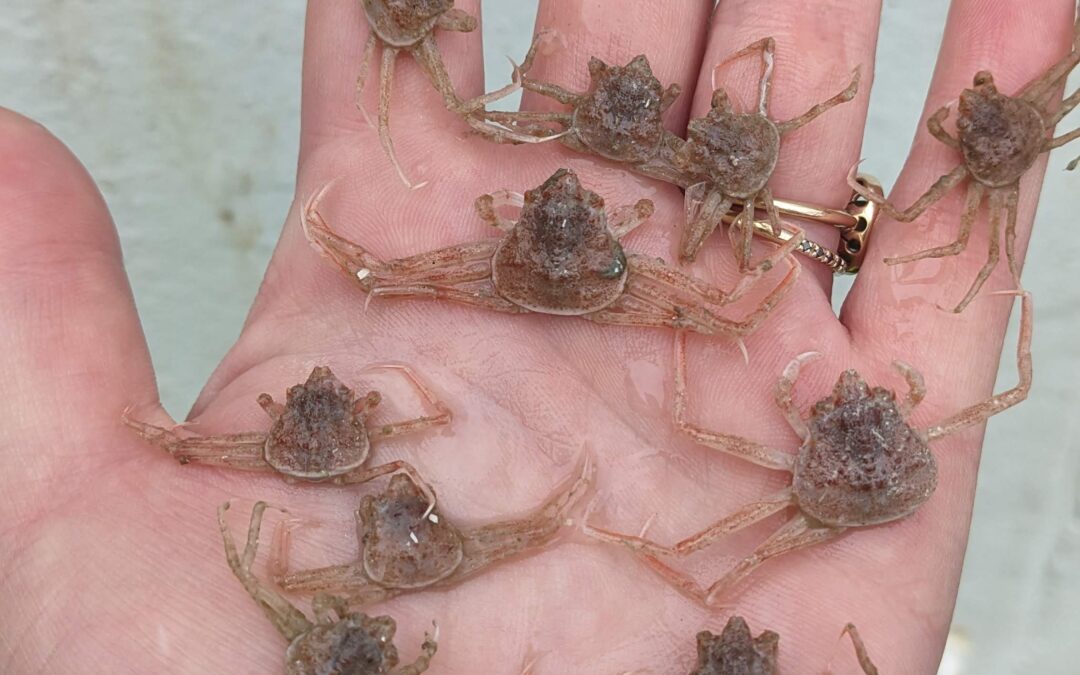
Between 2019 and 2021, the EBS snow crab (Chionoecetes opilio) population experienced an unprecedented collapse, with more than 10 billion crab disappearing.
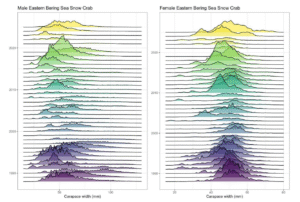
Historical size frequency for snow crab (Chionoecetes opilio) in the eastern Bering Sea (Zacher et al., 2025).
Research has attributed the collapse to marine heatwaves, in which elevated temperatures dramatically increased the crabs’ metabolic demands while contracting their spatial distribution (Szuwalski et al., 2023). The combination of these stressors likely led to the widespread mortality event induced.
However, recent EBS survey data from 2025 have provided some good news (Zacher et al., 2025). A pulse of small snow crab is now being observed in survey catches, indicating a recent successful recruitment event. Additionally, surveys are documenting high abundances of very large female snow crab, which could be promising for future reproductive output!
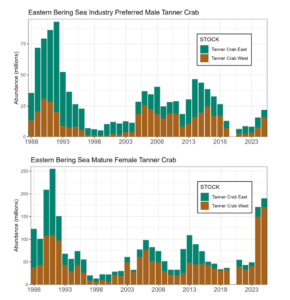
Combined historical abundance of mature female and industry-preferred size male (carapace
width ≥ 125 mm) Tanner crab (Chionoecetes bairdi) in the eastern Bering Sea (Zacher et al., 2025).
Western Tanner crab (C. bairdi) populations are continuing to improve, with stable to increasing trends in recent years. This does, however, contrast with their eastern counterparts, highlighting the regional variability in Tanner crab distribution.
But perhaps the most surprising news is the appearance of a substantial pulse of hybrid Chionoecetes, never before seen in the Bering Sea (Zacher et al., 2025). Hybridization between snow crab and Tanner crab can and does occur, but typically represents a small proportion of the crabs.
This year, hybrids have spiked dramatically, and this could be related to conditions that encouraged interbreeding between snow and Tanner crab following the snow crab population crash. Whether these hybrids will persist or represent a temporary phenomenon remains an open question, and there are future plans for closely monitoring the presence of hybrids in BSFRF survey work planned for the summer of 2026.
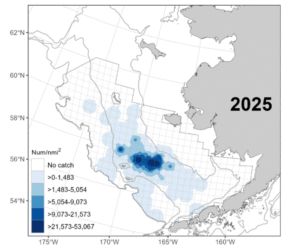
Estimated total density of legal-sized (≥ 78 mm carapace width) male hybrid Chionoecetes
spp. (Zacher et al., 2025)
While these recent observations offer some cautious optimism, the long-term trajectory of these crabs remains uncertain.
References:
Szuwalski, C.S., Aydin, K., Fedewa, E.J., Garber-Yonts, B. and Litzow, M.A. (2023) The collapse of eastern Bering Sea snow crab. Science, 382(6668), 306-310.
Zacher, L.S., Hennessey, S.M., Richar, J.I., Fedewa, E.J., Ryznar, E.R. and Litzow, M.A. (2025) The 2025 eastern Bering Sea continental shelf trawl survey: Results for commercial crab species. NOAA Technical Memorandum NMFS-AFSC (Draft).